
From Insight to Transformation: Why MINDSHIFT Is More Than the Sum of Its Inspirations
Philippe Joannis
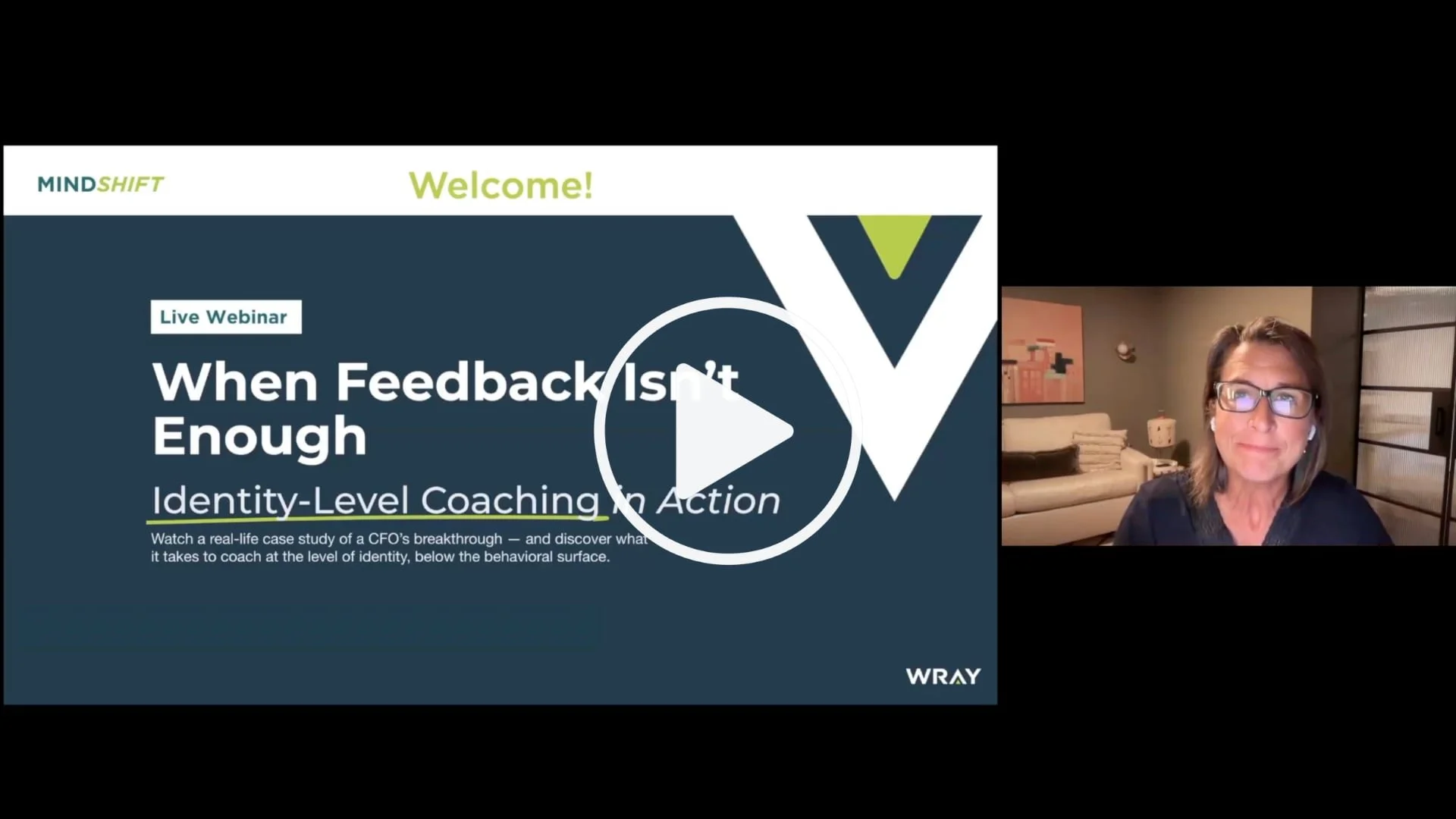
I just watched Alex Wray and Catherine Allen’s webinar on the theme “When Feedback Is Not Enough,” which gives a very good view of the MINDSHIFT process (developed by Alex), using the testimonial of James, a client who went through the process, as a real-life example.
Click here to watch the webinar:
I went through the MINDSHIFT process training myself a few years ago, and I was really impressed by the quality of the program's design. But watching this webinar gave me the desire to put into words what makes MINDSHIFT special.
What strikes me about the MINDSHIFT process is that it is not simply another coaching framework, nor is it a repackaging of existing theories of adult development, Immunity to Change, or cognitive inquiry. Its real value, in my own experience, is that it operationalizes several powerful sources of insight into a coherent and deeply human coaching journey. It takes ideas that many of us already know — from the Leadership Circle, Kegan and Lahey’s Immunity to Change, above/below-the-line work (Conscious Leadership Group), Byron Katie’s inquiry (The Work), and broader developmental theory — and sequences them in such a way that real transformation becomes more possible. For me, this distinction matters.
Many frameworks are brilliant as maps, and they help us understand what might be happening. They offer language, concepts, distinctions, and conceptual clarity. But in the actual coaching room, the question is different: How do I support this person’s desire to move from insight to transformation? How do I support a leader to not only understand their pattern, but meet it, feel it, question it, loosen it, and then practice a different way of being in the very situations where the old pattern usually takes over?
And this is where MINDSHIFT becomes more than the sum of its inspirations — many of which I already knew quite well before taking the program. (I am trained in Immunity to Change, faculty of the Leadership Circle, trained by the Conscious Leadership Group in their framework where below and above the line are central, and very familiar with The Work of Byron Katie.)
The Leadership Circle 360 Profile, for example, plays a crucial role at the beginning of the journey. It gives the client a powerful mirror. It shows how their leadership is experienced by others, and it helps reveal the relationship between Reactive patterns and Creative capacities. In this webinar, James’s Leadership Circle profile helped him see something that, at some level, he already knew but had not fully faced: the very strengths that had previously brought him success were now creating costs. He could see that his intensity, his need to win, and his drive to prove the right answer were not simply “bad behaviors”; they were reactive expressions of something deeper.
MINDSHIFT takes ideas that many of us already know — TLC, Immunity to Change, Byron Katie’s The Work, and broader developmental theory — and sequences them in such a way that real transformation becomes more possible.
That is already valuable. But MINDSHIFT does not stop with the LC profile. The Leadership Circle helps identify the “one big thing,” the central pattern that matters most for the leader’s next stage of growth. It opens the door to a developmental conversation, but it is not the whole journey. A 360 can produce clarity, humility, and even motivation. But clarity alone does not transform. Many leaders understand their 360 feedback and yet still repeat the same behavior under pressure. That is because the real driver of the behavior often lives below conscious intention.
This is where the above/below-the-line distinction becomes very helpful. It normalizes reactivity. It allows the client to see that when they become defensive, controlling, compliant, withdrawn, or over-forceful, they are not simply being irrational or “difficult.” They are often in a state of threat. Their nervous system is organizing around protection. In James’s case, disagreement in an executive meeting was not experienced as a neutral exchange of views. It felt like a threat to identity. He was not just arguing for an idea; he was, at some level, fighting for his place ("to belong").
This is important because shame rarely produces transformation. If a leader experiences their pattern as a personal defect, they may defend against the feedback or collapse into guilt. But if they can see, “Ah, this is what happens when I go below the line,” then the pattern becomes observable. It becomes workable. It is still serious, but it is less fused with identity. The client can begin to notice their state rather than be completely run by it.
Kegan and Lahey’s Immunity to Change is another key source of inspiration. It provides a powerful architecture for understanding why sincere commitments to change are often blocked by hidden commitments and big assumptions. I have always found this model intellectually elegant and profoundly useful. It shows that what often looks like resistance is often a form of protection. The client is not simply failing to change; they are actively and intelligently protecting themselves from a feared outcome.
But here is where I believe MINDSHIFT goes much further — or at least becomes more practical and more transformational in the coaching room. The classic Immunity to Change process can often remain quite cognitive. The four-column map is powerful, but it can be completed too quickly. A client can arrive at a “big assumption” that sounds right, even insightful, without necessarily touching the emotional or somatic reality that gives the assumption its power. The result can be a beautiful sentence, but does not yet provide a shift in the person’s inner world.
MINDSHIFT slows this down. It creates more granularity between the steps. It does not rush from the improvement goal to the big assumption (ITC)/Limiting Belief. It uses specific contexts and helps the client enter through a concrete situation, name the reactive behavior, explore the uncomfortable opposite, identify the worries that arise, follow those worries down to the identity threat, and only then formulate the limiting belief.
In James’s case, the belief “If I’m wrong, I don’t belong” was not just a clever insight. It was discovered as a lived reality. He described it as “life or death,” like being caught in a riptide where letting go meant drowning. That difference is crucial for me. MINDSHIFT is not just interested in the belief as a thought. It is interested in the belief as a nervous-system reality. The belief is not merely something the client thinks. It is something their whole system has learned to organize around. That is why the work has to be slower, deeper, and more embodied than purely cognitive inquiry.
This is also where I see the influence of Byron Katie’s Work. Once a limiting belief is identified, MINDSHIFT does not simply say, “Now let’s replace it with a positive affirmation.” It invites inquiry. It plays with the belief. It explores inversions — what MINDSHIFT describes as “the plot twist.” It asks whether the opposite, or a variation of the opposite, might also contain truth.
For instance, a leader may carry a belief such as: “I belong when I do my job by pushing people’s limits and telling them what they need to do.” That belief may have been adaptive for years. It may have helped them succeed. But MINDSHIFT allows the coach and client to turn it, test it, and loosen it: Could it also be true that “I don’t belong when I push people’s limits and tell them what to do”? Could it be true that “I belong when I empower others rather than force my answer”? Could it be true that “My job is not to prove my value by having the answer, but to create the conditions for others to think, contribute, and shine”?
This is not abstract reframing. It becomes the basis for experimentation. The client begins to test new beliefs in real situations. They do not have to believe the new formulation. They only need to become curious enough to act from it and see what happens.
For me, this is one of the most important contributions of MINDSHIFT: it does not confuse insight with transformation. Insight is necessary, but it is not sufficient. Seeing the prison cell is not the same as walking out of it. Alex makes this point clearly through this metaphor: turning the lights on in the cell allows you to see the walls and the bars, but it does not yet get you out of the cell.
The real work begins after the insight. The client has to learn to stay present in the trigger. This is where MINDSHIFT becomes much less cognitive and much more developmental. The work is no longer only “What do I believe?” It becomes: "Can I remain present when the old belief is activated? Can I feel the threat and not be taken over by it? Can I pause, challenge, and choose while my nervous system desperately wants to fight, flee, freeze, please, or prove?"
That is a very different kind of coaching. It is not behavior modification. It is not simply cognitive restructuring. It is the building of a new inner capacity.
In James’s case, the shift was not that he stopped caring or became passive. It was that he could remain steady enough in disagreement to choose his response. He could “plant a seed” instead of taking someone to the mat. He could decide which battles mattered. He could accept that he might not win a particular argument and still belong.
This is also why I think the templates/exercises offered in the MINDSHIFT process, and its 5 many phases, are so important. They are not administrative tools. They are not just worksheets. They create a container for depth. They give the coach enough structure to stay with the client when the work becomes emotionally charged. They also give the client a path, so that the work does not feel like an uncontrolled dive into the unconscious. It is a way to hold both rigor and humanity.
The MINDSHIFT coaching process is not behavior modification. It is not simply cognitive restructuring. It is the building of a new inner capacity.
This is also why I think the templates/exercises offered in the MINDSHIFT process, and its 5 many phases, are so important. They are not administrative tools. They are not just worksheets. They create a container for depth. They give the coach enough structure to stay with the client when the work becomes emotionally charged. They also give the client a path, so that the work does not feel like an uncontrolled dive into the unconscious. It is a way to hold both rigor and humanity.
I also discovered that MINDSHIFT is a method for developing the coach. To work this way, the coach must be able to stay present with discomfort, fear, shame, and identity threat. Catherine says very honestly — and I can relate to this in my own experience — that before having the method, she could sense there was something deeper with clients, but did not always know how to stay with it or where to take it. The MINDSHIFT structure gave her “steadiness”.
This is very important. Many coaches are attracted to deep work, but depth without structure can become fuzzy, vague, risky, or overly dependent on intuition. Conversely, structure without depth becomes mechanical. (It reminds me of Cage’s quote: “Structure without life is dead, but life without structure is unseen. Pure life expresses itself within and through structure.”)
In that sense, MINDSHIFT is a living process. It offers both a disciplined sequence and enough psychological depth to make the sequence transformational rather than procedural. Life finds its way toward more freedom.
So, from my insider experience, MINDSHIFT is not a copy of anything, and its value is not that it invented all its components. It did not — and that is not the point. Its value lies in how it curates, sequences, deepens, and makes them actionable and operational.
The Leadership Circle helps reveal the pattern. Above/below the line helps the client recognize their state. Kegan and Lahey help uncover the protective armour/architecture. Byron Katie-style inquiry helps loosen the belief and open new possibilities. The structured exercises and experiments help translate insight into embodied practice.
The result is a coaching process that moves through several layers: feedback, pattern recognition, state awareness, identity-level inquiry, belief loosening, nervous-system retraining, and real-world experimentation. That is a much richer journey than simply identifying a big assumption.
And what I appreciate most is that MINDSHIFT respects the intelligence of the old pattern. It does not treat reactivity as stupidity. It understands that reactive patterns were often built through success, reinforcement, and belonging. In that sense, it is very “integral”: it helps include and transcend the past.
James’s “Viking” identity worked for him for years. It got him recognition. It helped him feel needed. It helped him rise. But eventually, the same identity became too small for the leadership required of him. That is the developmental edge. The task is not to destroy the old self, but to release the leader from being governed by it.
James does not lose his strength. He does not become weak, agreeable, compliant, or bland. He becomes freer. His force is no longer organized around proving that he belongs, but he becomes available for something more creative: helping others succeed and shine.
That is why I would describe MINDSHIFT as a practice of identity-level transformation. It is more than the sum of its sources because it brings them together in a way that is usable, embodied, and developmental. It helps a leader not only understand the belief that drives their reactivity, but experience enough safety, awareness, experimentation, and practice to live from a different belief — a new story. It transforms the inner game that drives the outer game. And in the end, the shift is not only from one behavior to another. It is from one inner world to another.
From: “If I’m wrong, I don’t belong.”
To: “I know I belong, and my role is to help others shine.”
This is not just behavior change. This is transformation.